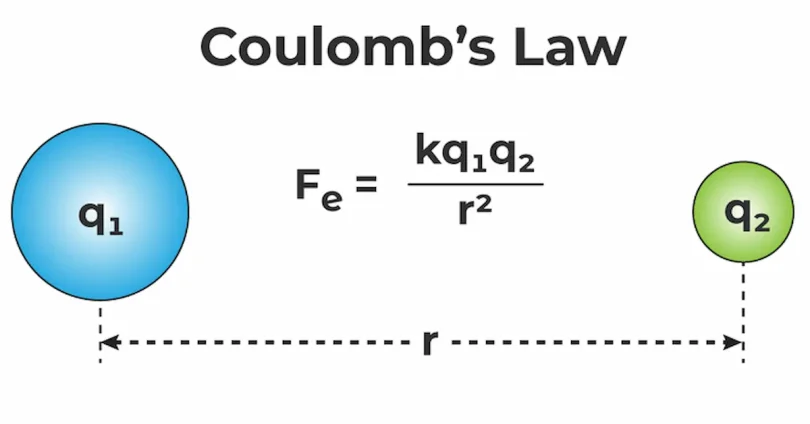

Coulomb’s law is an important principle in physics that explains the electric force between two charged objects. It describes how electric charges attract or repel each other depending on their charge values and the distance between them. This law helps students understand the basic principles of electricity and electrostatics.
Coulomb’s law states that the electric force between two point charges increases when the charges become larger and decreases as the distance between them increases. Opposite charges attract each other, while charges of the same type repel each other. These interactions are essential for understanding how electric charges behave.
In this article, you will learn what Coulomb’s law is, its formula, how it works, and the factors that affect electric force. You will also explore real-life examples, solved numerical problems, and practical applications to make this physics concept easier to understand.
What Is Coulomb’s Law?
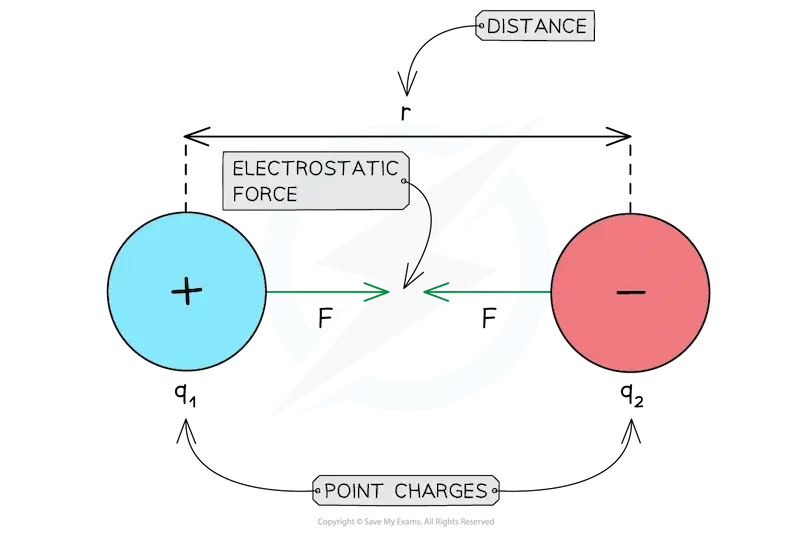
Coulomb’s law is a fundamental law of physics that explains the electrostatic force between two electrically charged objects. It states that the force depends on the amount of charge on each object and the distance between them. The law was introduced by French physicist Charles-Augustin de Coulomb in the 18th century.
Understanding Coulomb’s Law in Simple Words
Every electrically charged object can exert a force on another charged object. This force can either pull the objects toward each other or push them apart.
There are two basic rules to remember:
- Like charges repel: Two positive charges or two negative charges push each other away.
- Opposite charges attract: A positive charge and a negative charge pull each other together.
How Does Distance Affect the Force?
The distance between two charges plays an important role in determining the strength of the electric force. When the charges are closer together, the force is stronger. When the distance increases, the force becomes weaker.
For example, if the distance between two point charges doubles, the electrostatic force becomes one-fourth as strong, provided the charges and surrounding medium remain unchanged.
Why Is Coulomb’s Law Important?
Coulomb’s law helps explain how electric charges interact in different situations. It is useful in studying electrostatics, atoms, molecules, and many electrical systems. Understanding this law also prepares students to learn more advanced topics in electricity and electromagnetism.
Coulomb’s Law Formula Explained
Coulomb’s law uses a mathematical formula to calculate the electric force between two point charges. The formula helps us understand how the amount of charge and the distance between charges affect the strength of the force.
\(F = k\frac{q_1q_2}{r^2}\)
\(|F|=k\frac{|q_1q_2|}{r^2}=\frac{(8.99\times10^9)(|\text{3}\cdot\text{-3}|)}{\text{4}^2}=5.06\times10^9\,\text{N}\)
\(q_1\)
C
\(q_2\)
C
\(r\)
m
+-q₁ = 3 Cq₂ = -3 Cr = 4 m
Give feedback
What Is the Formula for Coulomb’s Law?
The magnitude of the electrostatic force between two point charges in a vacuum is calculated using this formula:
\[ F=k\frac{|q_1q_2|}{r^2} \]
Meaning of Each Symbol
- F: Magnitude of the electrostatic force, measured in newtons (N).
- k: Coulomb’s constant, approximately \(8.99\times10^9\ \text{N}\cdot\text{m}^2/\text{C}^2\) in a vacuum.
- q₁: Electric charge of the first object, measured in coulombs (C).
- q₂: Electric charge of the second object, measured in coulombs (C).
- r: Distance between the two charges, measured in meters (m).
- Square of distance (\(r^2\)): The distance is multiplied by itself in the denominator.
The absolute value signs mean that this formula calculates the force’s magnitude. The signs of the charges determine whether the force is attractive or repulsive.
Example of Coulomb’s Law
Suppose two point charges are each \(2\) microcoulombs in magnitude and are separated by a distance of \(0.5\) meters in a vacuum.
Given values:
- \(q_1=2\times10^{-6}\ \text{C}\)
- \(q_2=2\times10^{-6}\ \text{C}\)
- \(r=0.5\ \text{m}\)
- \(k=8.99\times10^9\ \text{N}\cdot\text{m}^2/\text{C}^2\)
Step 1: Substitute the values.
\[ F=\frac{(8.99\times10^9)(2\times10^{-6})(2\times10^{-6})}{(0.5)^2} \]
Step 2: Calculate the result.
\[ F\approx0.144\ \text{N} \]
The magnitude of the electric force is approximately 0.144 newtons. If both charges are positive, or both are negative, the force is repulsive. If one charge is positive and the other is negative, the force is attractive.
Why Is the Coulomb’s Law Formula Useful?
This formula helps students solve electrostatics problems and predict how charges interact. It shows that larger charges produce a stronger force, while greater separation reduces the force. These relationships are important for understanding electric fields, charged particles, and many applications of electricity.
How Does Coulomb’s Law Work?
Coulomb’s law explains how two electrically charged objects exert forces on each other. The force depends on the amount of charge, the distance between the objects, and the surrounding material. It helps us understand why some charged objects attract each other while others move apart.
1. Like Charges Repel Each Other
When two positive charges or two negative charges are brought close together, they push each other away. This is called a repulsive force. For example, two objects carrying the same type of electric charge will tend to move apart if they are free to move.
2. Opposite Charges Attract Each Other
When one object has a positive charge and another has a negative charge, they attract each other. This is called an attractive force. The electric force pulls the two objects toward each other.
3. The Force Changes With Distance
The distance between two charges affects the strength of the electric force. When the charges are close together, the force is stronger. As the distance increases, the force becomes weaker.
For example, if the distance between two point charges doubles, the force becomes one-fourth of its original magnitude. If the distance triples, the force becomes one-ninth as strong, assuming the charges and surrounding medium remain unchanged.
4. Larger Charges Produce a Stronger Force
The amount of electric charge also affects the force. If the distance stays the same, increasing the magnitude of either charge increases the force. For example, doubling one charge doubles the force, while doubling both charges makes the force four times greater.
5. The Surrounding Material Can Affect the Force
Coulomb’s law also depends on the material between the charges. In a material such as glass or water, the electrostatic force can differ from the force between the same charges in a vacuum. The basic formula must account for the medium’s electrical properties.
Why Is This Important?
Coulomb’s law helps explain how charged particles interact in physics and chemistry. It is useful for understanding static electricity, electric fields, and the behavior of charged particles. By learning how charge and distance affect the force, students can solve electrostatics problems more easily.
Factors Affecting Electrostatic Force
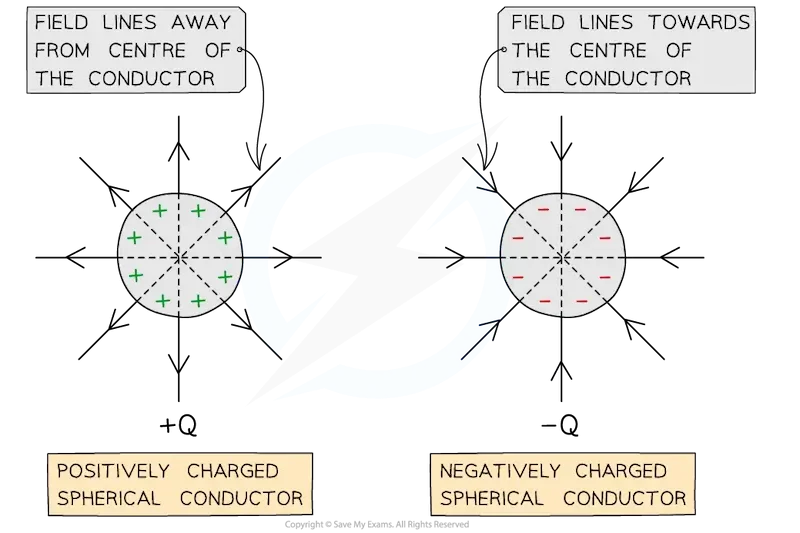
Electrostatic force is the force of attraction or repulsion between electrically charged objects. According to Coulomb’s law, several factors determine the strength and direction of this force. Understanding these factors makes it easier to explain how electric charges behave in different situations.
1. Amount of Electric Charge
The amount of charge on each object affects the strength of the electrostatic force. When the magnitude of one or both charges increases, the force also increases if the distance and surrounding medium remain unchanged.
For example, if one charge doubles while the other charge stays the same, the force doubles. If both charges double, the force becomes four times greater.
2. Distance Between the Charges
The distance between two charged objects has a major effect on the force between them. The force follows an inverse-square relationship with distance, meaning it decreases rapidly as the objects move farther apart.
For example, if the distance between two charges doubles, the force becomes one-fourth of its original value. If the distance is reduced to half, the force becomes four times stronger.
3. Type of Charges
The signs of the charges determine whether the force is attractive or repulsive.
- Positive and positive: The charges repel each other.
- Negative and negative: The charges repel each other.
- Positive and negative: The charges attract each other.
The charge signs determine the direction of the force, while the charge magnitudes and separation determine its strength.
4. Surrounding Material
The material between two charges can affect the strength of the electrostatic force. For example, the force between charges in water can differ significantly from the force between the same charges in a vacuum because water has different electrical properties.
For a uniform, isotropic medium, the force depends on the medium’s permittivity. A higher permittivity generally results in a weaker electrostatic force for the same charges and distance.
5. Position of the Charges
The positions of charged objects determine the direction in which the forces act. For two point charges, the force acts along the straight line connecting them. When several charges are present, the total force on an object depends on the combined effects of the forces from the other charges.
Why Are These Factors Important?
These factors help students understand and calculate electrostatic forces in physics problems. They also explain real-world phenomena involving static electricity, charged particles, and electrical interactions. By understanding charge, distance, and the surrounding material, you can apply Coulomb’s law more accurately.
What is Coulomb’s law?
Coulomb’s law explains the electric force between two charged objects. It states that the force depends on the size of the charges and the distance between them. Like charges repel, while opposite charges attract.
What is the formula for Coulomb’s law?
The formula for Coulomb’s law is:
\[ F=k\frac{|q_1q_2|}{r^2} \]
Here, \(F\) is the electric force, \(q_1\) and \(q_2\) are the charges, \(r\) is the distance between them, and \(k\) is Coulomb’s constant.
What is Coulomb’s constant?
Coulomb’s constant is represented by \(k\). Its approximate value in a vacuum is \(8.99\times10^9\ \mathrm{N\,m^2/C^2}\). It is used to calculate the electric force between charged objects.
Conclusion
Coulomb’s law is an important principle in physics that explains the electric force between charged objects. It helps us understand how electric charges attract or repel each other based on their size and the distance between them. By learning the Coulomb’s law formula, its factors, and practical examples, students can better understand electrostatic forces and their applications in everyday life, science, and technology.