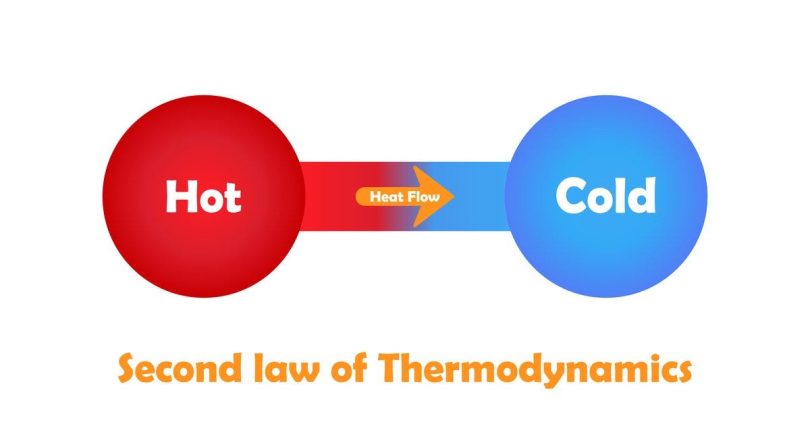

The second law of thermodynamics is an important principle in physics that explains how heat and energy behave in nature. It helps us understand why heat naturally flows from a hotter object to a colder object and why some energy becomes less available for useful work.
The second law of thermodynamics also introduces the concept of entropy, which describes how energy spreads out and how natural processes tend to occur in a particular direction. From a cooling cup of coffee to the operation of refrigerators and car engines, this law helps explain many everyday activities. Understanding it makes it easier to learn how energy works and why no real heat engine can convert all the heat it receives into useful work in a cycle.
What Is the Second Law of Thermodynamics?
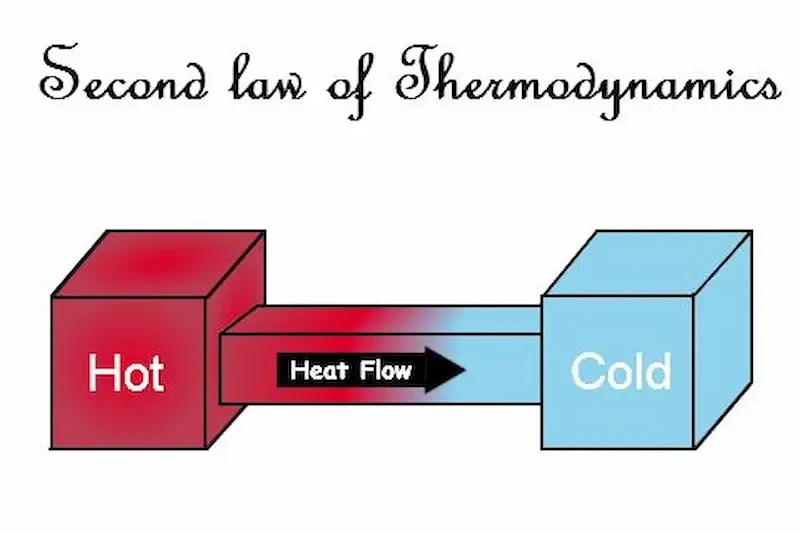
The second law of thermodynamics is a fundamental principle of physics that explains how heat and energy behave in natural processes. It states that the total entropy of an isolated system tends to increase or remain constant. In simple words, energy naturally spreads out, and many processes happen in a particular direction.
Understanding the Second Law in Simple Words
The second law of thermodynamics helps us understand why heat naturally flows from a hotter object to a colder object. It also explains why some energy becomes less available for doing useful work during real-world processes.
For example, when you leave a hot cup of tea in a cool room, heat moves from the tea into the surrounding air. As a result, the tea gradually cools down. It does not become hot again by absorbing heat from the cooler air on its own.
Why Is the Second Law Important?
The second law of thermodynamics is important because it explains the limits of energy conversion. A heat engine cannot convert all the heat it receives into useful work during a complete cycle. Some heat must be released to a colder area.
This principle helps scientists and engineers understand how car engines, refrigerators, air conditioners, and power plants work. It also helps them improve energy efficiency and reduce energy waste.
Statements of the Second Law of Thermodynamics
The second law of thermodynamics can be explained in different ways. Two of the most important statements are the Kelvin–Planck statement and the Clausius statement. Both explain the natural behavior of heat and the limitations of energy conversion.
1. Kelvin–Planck Statement
The Kelvin–Planck statement explains that a heat engine cannot convert all the heat it receives into useful work during a complete cycle. Some heat must be released to a cooler surrounding area or reservoir.
For example, a car engine burns fuel to produce heat and convert some of that energy into mechanical work. However, not all the energy becomes useful movement. Some is released through the exhaust and cooling system. This is why no real heat engine can achieve 100% thermal efficiency.
2. Clausius Statement
The Clausius statement explains that heat cannot flow from a colder object to a hotter object by itself without an external effect. Under natural conditions, heat flows from a warmer object to a cooler one.
For example, when you place ice in a glass of warm water, heat moves from the water to the ice, causing it to melt. However, a refrigerator can transfer heat from its cold interior to the warmer room because it uses electrical energy to operate.
3. Entropy Statement
The second law can also be explained through entropy. For an isolated system, the total entropy never decreases. It remains constant in an ideal reversible process and increases in an irreversible process.
For example, when perfume is sprayed in one corner of a room, its particles gradually spread throughout the air. They do not naturally gather back into the original corner. This illustrates how a process can move toward a more widely distributed state.
Why Are These Statements Important?
These statements describe the same fundamental principle from different perspectives. The Kelvin–Planck statement explains the limits of heat engines, while the Clausius statement describes the direction of heat transfer. The entropy statement provides a broader way to understand why natural processes occur in a particular direction.
Formula of the Second Law of Thermodynamics
The second law of thermodynamics is closely related to entropy, which helps explain how energy spreads during a process. Its mathematical expression allows us to understand whether a process is reversible or irreversible and how entropy changes when heat is transferred.
1. Entropy Change Formula
The entropy change for a reversible process can be calculated using the following formula:
\[ \Delta S=\frac{Q_{\mathrm{rev}}}{T} \]
Where:
- \(\Delta S\) = change in entropy, measured in joules per kelvin (J/K).
- \(Q_{\mathrm{rev}}\) = heat transferred reversibly, measured in joules (J).
- \(T\) = absolute temperature, measured in kelvin (K).
This formula applies directly when heat is transferred reversibly at a constant temperature. For a reversible process with changing temperature, entropy change is calculated by integrating the heat transfer divided by the absolute temperature.
2. Entropy Principle for an Isolated System
The second law states that the total entropy of an isolated system cannot decrease. It can be expressed as:
\[ \Delta S_{\mathrm{total}}\geq 0 \]
This means:
- \(\Delta S_{\mathrm{total}}=0\): The process is reversible in the ideal thermodynamic sense.
- \(\Delta S_{\mathrm{total}}>0\): The process is irreversible.
- \(\Delta S_{\mathrm{total}}<0\): This is not possible for the total entropy change of an isolated system.
3. Example of the Entropy Formula
Suppose 200 joules of heat are transferred reversibly to a system at a constant temperature of 400 kelvin.
Using the formula:
\[ \Delta S=\frac{Q_{\mathrm{rev}}}{T} \]
\[ \Delta S=\frac{200}{400} \]
\[ \Delta S=0.5\ \mathrm{J/K} \]
Therefore, the entropy of the system increases by 0.5 joules per kelvin.
Why Is This Formula Important?
The entropy formula helps scientists and engineers analyze heat transfer, energy efficiency, and thermodynamic processes. It is useful for understanding heat engines, refrigerators, power plants, and other systems where energy changes from one form to another. It also helps determine whether a process can occur naturally under the stated conditions.
What Is Entropy in Thermodynamics?
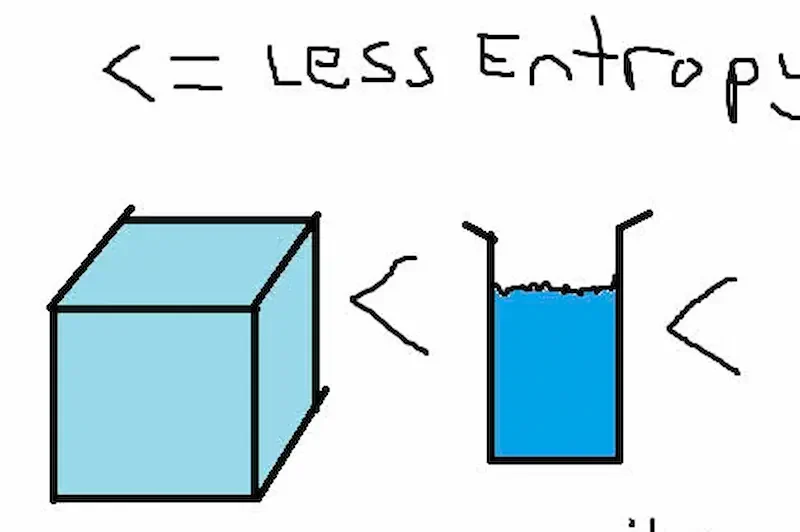
Entropy is an important concept in the second law of thermodynamics. It describes how energy is distributed within a system and helps explain why certain natural processes happen in one direction. Entropy is measured in joules per kelvin (J/K).
In simple words, entropy helps us understand why heat spreads from warmer objects to cooler surroundings and why many natural processes do not reverse themselves automatically. Although entropy is often described as a measure of disorder, it is more accurately related to the number of possible microscopic arrangements of a system and the distribution of energy.
1. How Does Entropy Work?
Entropy changes when heat moves, substances mix, or other physical processes occur. In an isolated system, total entropy remains constant during an ideal reversible process and increases during an irreversible process.
For example, when you spray perfume in a room, its particles gradually spread through the air. They move from a concentrated area into a larger space. The perfume does not naturally collect itself back into the bottle because the spread-out state is overwhelmingly more probable.
2. Relationship Between Entropy and Heat
Heat transfer can change the entropy of an object. When heat enters an object, its entropy may increase; when heat leaves, its entropy may decrease. However, the total entropy of the object and its surroundings must be considered to understand the second law.
For example, when hot tea cools down in a room, the tea loses heat and its entropy decreases. At the same time, the surrounding air gains heat and its entropy increases. The total entropy of the tea and its surroundings increases during this natural, irreversible process.
3. Entropy and Temperature
Entropy and temperature are related, but they are not the same. Temperature measures how hot or cold something is, while entropy describes aspects of energy distribution and the possible microscopic states of a system.
For a reversible heat transfer at a constant absolute temperature, entropy change can be calculated using:
\[ \Delta S=\frac{Q_{\mathrm{rev}}}{T} \]
Here, \(\Delta S\) is the entropy change, \(Q_{\mathrm{rev}}\) is the heat transferred reversibly, and \(T\) is the absolute temperature in kelvin.
4. Why Is Entropy Important?
Entropy helps explain why real-world processes have a preferred direction and why energy cannot always be converted completely into useful work. It is also essential for understanding engines, refrigerators, chemical reactions, and power generation.
By studying entropy, scientists and engineers can analyze energy losses, improve system efficiency, and understand the physical limits of machines. This makes entropy one of the key concepts for understanding the second law of thermodynamics.
What is the second law of thermodynamics in simple words?
The second law of thermodynamics states that the total entropy of an isolated system never decreases. It explains why heat naturally flows from hotter objects to colder objects and why many natural processes occur in a particular direction.
What is the main principle of the second law of thermodynamics?
The main principle is that the total entropy of an isolated system remains constant in an ideal reversible process and increases in an irreversible process. It also explains why heat engines cannot convert all the heat they receive into useful work during a complete cycle.
What is the formula for the second law of thermodynamics?
One important mathematical expression is:
\[ \Delta S_{\text{total}}\geq 0 \]
This means the total entropy change of an isolated system is zero for an ideal reversible process and greater than zero for an irreversible process.
Conclusion
The second law of thermodynamics is a fundamental principle of physics that explains how heat and energy behave in natural processes. It shows that the total entropy of an isolated system never decreases and explains why heat naturally flows from hotter objects to colder ones. By understanding entropy, heat transfer, and energy efficiency, we can better understand how engines, refrigerators, air conditioners, and power plants work. The second law of thermodynamics is essential in science and engineering because it helps explain the limits of energy conversion and the direction of many everyday processes.