
Raoult’s Law is an important principle in chemistry that explains how the vapor pressure of a solution changes when different substances are mixed together. It helps students understand the relationship between the amount of each component in a solution and its vapor pressure.
Raoult’s Law is especially useful for studying ideal solutions, liquid mixtures, and the behavior of solvents and solutes. It also helps explain colligative properties and some processes used to separate liquid mixtures. By understanding its definition, formula, and examples, students can solve chemistry problems more easily and build a strong foundation in physical chemistry.
What Is Raoult’s Law?

Definition of Raoult’s Law
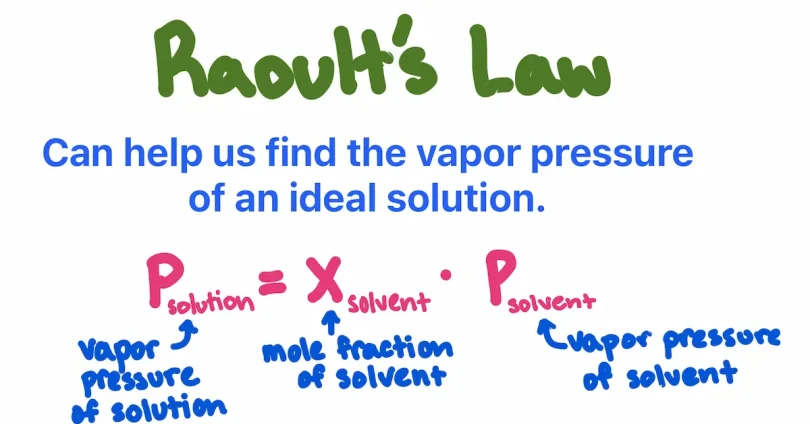
Raoult’s Law states that the partial vapor pressure of a component in an ideal solution is equal to the vapor pressure of that pure component multiplied by its mole fraction in the solution. This law was introduced by French chemist François-Marie Raoult and is an important concept in physical chemistry.
Raoult’s Law in Simple Words
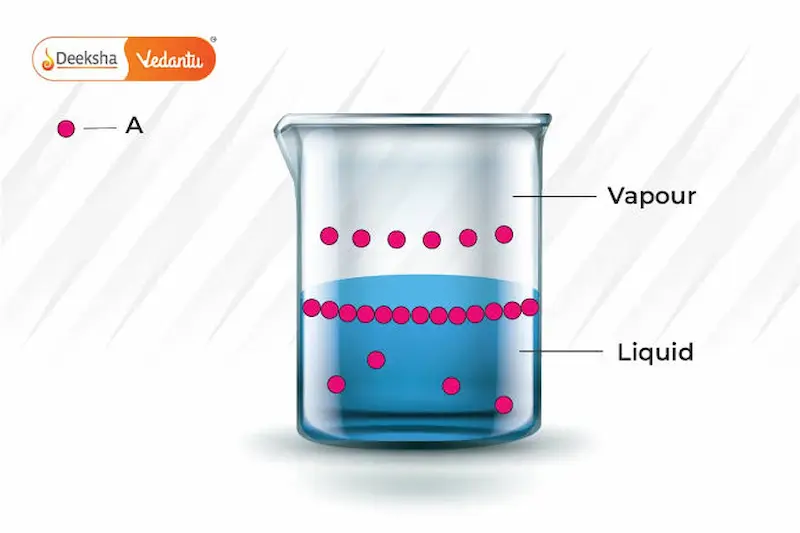
In simple terms, Raoult’s Law explains how adding one substance to another can change the vapor pressure above a liquid. When a non-volatile solute, such as sugar, dissolves in a solvent, such as water, fewer solvent molecules are present at the liquid surface to escape into the vapor phase. As a result, the vapor pressure of the solution becomes lower than that of the pure solvent at the same temperature.
Role of Solvent and Solute
A solvent is the substance that dissolves another substance, while a solute is the substance being dissolved. For example, in a sugar-water solution, water is the solvent and sugar is the solute. Since sugar is non-volatile under ordinary conditions, it lowers the vapor pressure of the water when dissolved in it.
Why Is Raoult’s Law Important?
Raoult’s Law helps explain the behavior of liquid solutions and provides a useful way to calculate vapor pressure. It is used to study ideal mixtures, understand the effect of dissolved substances on vapor pressure, and introduce important concepts related to colligative properties. The law works best for ideal solutions, where the interactions between different molecules are similar to those in the pure substances.
Raoult’s Law Formula
Raoult’s Law uses a simple mathematical formula to calculate the partial vapor pressure of a component in an ideal solution. It shows how the vapor pressure depends on the mole fraction of that component and the vapor pressure of the pure substance at the same temperature.
1. Basic Formula of Raoult’s Law
The basic formula is:
\[ P_A = X_A \times P_A^0 \]
Where:
- \(P_A\) = Partial vapor pressure of component A in the solution
- \(X_A\) = Mole fraction of component A in the solution
- \(P_A^0\) = Vapor pressure of pure component A at the same temperature
This formula means that the partial vapor pressure of a component is equal to its mole fraction multiplied by the vapor pressure of its pure state.
2. Formula for Mole Fraction
Mole fraction tells us the proportion of a particular component in a mixture. It is calculated by dividing the number of moles of that component by the total number of moles of all components.
\[ X_A = \frac{n_A}{n_A+n_B} \]
Where:
- \(n_A\) = Number of moles of component A
- \(n_B\) = Number of moles of component B
The mole fractions of all components in a solution add up to 1.
\[ X_A+X_B=1 \]
3. Formula for Total Vapor Pressure
When a solution contains two volatile components, both can contribute to the total vapor pressure. The total vapor pressure is the sum of their partial vapor pressures.
\[ P_{\text{total}}=P_A+P_B \]
Using Raoult’s Law:
\[ P_{\text{total}}=X_AP_A^0+X_BP_B^0 \]
Here, \(P_B^0\) is the vapor pressure of pure component B, and \(X_B\) is its mole fraction in the solution.
4. Simple Example of Raoult’s Law
Suppose a solution contains component A with a mole fraction of 0.6. The vapor pressure of pure component A is 100 mmHg at a given temperature.
Using the formula:
\[ P_A=X_A\times P_A^0 \]
Substitute the values:
\[ P_A=0.6\times100 \]
\[ \boxed{P_A=60\text{ mmHg}} \]
Therefore, the partial vapor pressure of component A is 60 mmHg.
5. Why Is the Formula Important?
The Raoult’s Law formula helps students calculate vapor pressure and understand how the composition of a solution affects its behavior. By knowing the mole fraction and the vapor pressure of the pure component, we can calculate its partial vapor pressure in an ideal solution. For solutions containing two volatile components, the formula can also help determine the total vapor pressure.
How Does Raoult’s Law Work?
Raoult’s Law explains how the vapor pressure of a liquid solution depends on the amount of each component present in the mixture. To understand how it works, it is helpful to learn about vapor pressure, the movement of liquid molecules, and the role of mole fraction.
1. Understanding Vapor Pressure
Vapor pressure is the pressure created by vapor molecules above a liquid in a closed container when evaporation and condensation reach equilibrium. Some molecules at the liquid surface gain enough energy to escape into the vapor phase. At a given temperature, a liquid with a higher tendency to evaporate generally has a higher vapor pressure.
2. What Happens When a Solute Is Added?
When a non-volatile solute, such as sugar, is added to a solvent like water, the solute reduces the mole fraction of the solvent. As a result, the vapor pressure of the solution becomes lower than the vapor pressure of pure water at the same temperature, assuming the solution behaves ideally.
For example, pure water has a particular vapor pressure at a fixed temperature. When sugar dissolves in it, the vapor pressure decreases because the mole fraction of water becomes less than one.
3. The Role of Mole Fraction
Mole fraction is an important part of Raoult’s Law because it represents the proportion of a component in a mixture. A higher mole fraction of a volatile component generally means a higher partial vapor pressure, provided the solution follows Raoult’s Law.
For example, if a component has a mole fraction of 0.8 and its pure vapor pressure is 100 mmHg, its partial vapor pressure is:
\[ P_A=X_A\times P_A^0 \]
\[ P_A=0.8\times100=80\text{ mmHg} \]
Therefore, its partial vapor pressure is 80 mmHg.
4. What Happens in a Solution With Two Volatile Components?
When two volatile liquids are mixed, both components can evaporate and contribute to the total vapor pressure. According to Raoult’s Law, each component has its own partial vapor pressure based on its mole fraction and pure-component vapor pressure.
The total vapor pressure is calculated by adding the two partial pressures:
\[ P_{\text{total}}=P_A+P_B \]
This principle helps explain the behavior of mixtures such as benzene and toluene under conditions where they behave approximately ideally.
5. Why Does Raoult’s Law Matter?
Raoult’s Law makes it easier to predict the vapor pressure of ideal liquid solutions. It helps students understand how solution composition affects evaporation and provides a foundation for studying boiling points, colligative properties, and distillation. However, real solutions may not follow the law exactly because the attractions between different molecules can vary.
Examples of Raoult’s Law
Raoult’s Law becomes easier to understand when we apply its formula to simple examples. These examples show how mole fraction and the vapor pressure of a pure substance help us calculate the vapor pressure of a solution.
1. Example of a Non-Volatile Solute
Suppose a small amount of sugar is dissolved in water. The vapor pressure of pure water at a particular temperature is 40 mmHg, and the mole fraction of water in the solution is 0.75.
Using Raoult’s Law:
\[ P_A=X_A\times P_A^0 \]
Where:
- \(X_A=0.75\)
- \(P_A^0=40\text{ mmHg}\)
Now, substitute the values:
\[ P_A=0.75\times40 \]
\[ \boxed{P_A=30\text{ mmHg}} \]
The vapor pressure of water above the solution is 30 mmHg. This is lower than the vapor pressure of pure water because the mole fraction of water in the solution is less than 1.
2. Example of a Solution With Two Volatile Components
Consider an ideal solution containing two volatile liquids, A and B. Both components can evaporate and contribute to the total vapor pressure.
Suppose the following values are given:
- Mole fraction of A = 0.4
- Vapor pressure of pure A = 100 mmHg
- Mole fraction of B = 0.6
- Vapor pressure of pure B = 50 mmHg
First, calculate the partial vapor pressure of A:
\[ P_A=0.4\times100=40\text{ mmHg} \]
Next, calculate the partial vapor pressure of B:
\[ P_B=0.6\times50=30\text{ mmHg} \]
Now, calculate the total vapor pressure:
\[ P_{\text{total}}=P_A+P_B \]
\[ P_{\text{total}}=40+30 \]
\[ \boxed{P_{\text{total}}=70\text{ mmHg}} \]
Therefore, the total vapor pressure of the ideal solution is 70 mmHg.
3. Example Using Mole Fraction
Suppose a mixture contains 2 moles of component A and 3 moles of component B. To apply Raoult’s Law, we first need to calculate the mole fraction of each component.
The total number of moles is:
\[ n_{\text{total}}=2+3=5 \]
The mole fraction of A is:
\[ X_A=\frac{2}{5}=0.4 \]
The mole fraction of B is:
\[ X_B=\frac{3}{5}=0.6 \]
The sum of the mole fractions is:
\[ X_A+X_B=0.4+0.6=1 \]
These mole fractions can then be used in Raoult’s Law to calculate the partial vapor pressures, provided the vapor pressures of the pure components are known.
4. What Do These Examples Teach Us?
These examples demonstrate that Raoult’s Law connects the composition of a solution with its vapor pressure. A component’s partial vapor pressure depends on its mole fraction and the vapor pressure of the pure component at the same temperature. For a solution containing two volatile components, their partial vapor pressures are added to find the total vapor pressure.
Practicing these calculations helps students understand the formula and prepare for chemistry examinations. Remember that Raoult’s Law gives accurate predictions for ideal solutions, while real solutions may show deviations from the calculated values.
What Is Raoult’s Law in Simple Words?
Raoult’s Law explains how the vapor pressure of a component in an ideal solution depends on its mole fraction and the vapor pressure of the pure component at the same temperature.
What Is the Formula for Raoult’s Law?
The basic formula is \(P_A=X_A P_A^0\), where \(P_A\) is the partial vapor pressure, \(X_A\) is the mole fraction, and \(P_A^0\) is the vapor pressure of the pure component.
Who Discovered Raoult’s Law?
Raoult’s Law is named after French chemist François-Marie Raoult, who studied the vapor pressure of solutions.
Conclusion
Raoult’s Law is an important principle in physical chemistry that explains the relationship between the mole fraction of a component and its vapor pressure in an ideal solution. Its formula helps students calculate partial vapor pressure and total vapor pressure in mixtures containing volatile components. Understanding this law also makes it easier to learn about ideal solutions, positive and negative deviations, and colligative properties.
Raoult’s Law has useful applications in chemistry and the study of liquid mixtures. Although it works best for ideal solutions, real solutions may show deviations because of differences in intermolecular forces. By learning its definition, formula, and numerical examples, students can develop a better understanding of solution chemistry and solve related problems more confidently.