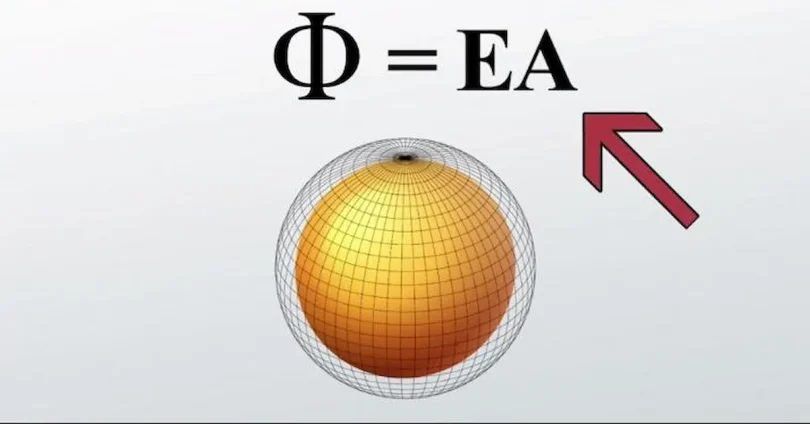

Gauss law is an important principle in physics that explains the relationship between electric charge and the electric field around it. It helps us understand how electric fields behave and how charges affect the space around them. This law is widely used in electrostatics to solve problems involving charged objects and electric fields.
Gauss law is especially useful when studying symmetrical charge distributions, such as charged spheres, long wires, and large flat sheets. It provides a simple mathematical method for calculating electric fields in these situations. By learning the meaning, formula, and applications of Gauss law, students can build a strong foundation in electricity and electromagnetism.
What Is Gauss Law?
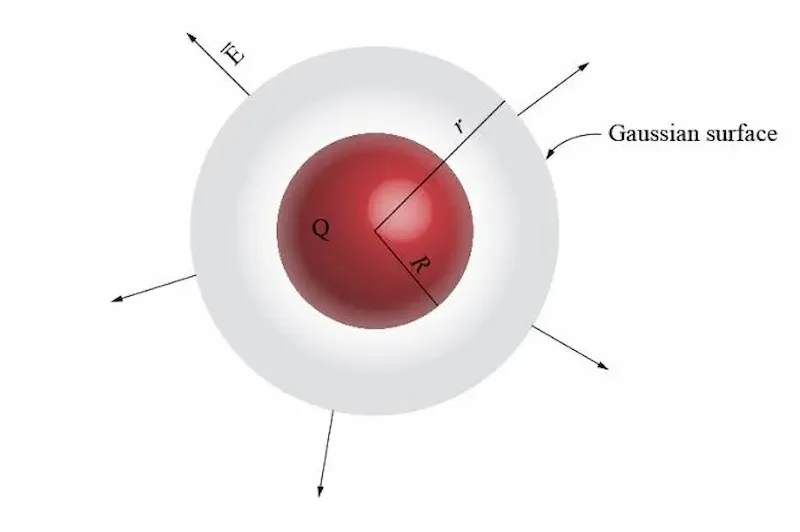
Gauss law is a fundamental principle of electromagnetism that explains how electric charge produces an electric field. It states that the total electric flux passing through any closed surface is equal to the total electric charge enclosed by that surface divided by the permittivity of free space. In simple words, Gauss law helps us understand how much electric field passes through a closed surface and how the charge inside that surface affects the result.
Gauss law was named after the German mathematician and physicist Carl Friedrich Gauss. It is one of the four Maxwell equations that form the foundation of classical electromagnetism. Students and scientists use this law to study electric fields and solve problems involving different types of charged objects.
How Does Gauss Law Explain Electric Fields?
An electric field is the region around an electric charge where another charge experiences an electric force. When a charged object is surrounded by an imaginary closed surface, Gauss law relates the electric flux through that surface to the amount of charge enclosed inside it.
For example, imagine placing a positive electric charge inside an imaginary sphere. The electric field points outward from the positive charge, and the total electric flux through the sphere depends on the enclosed charge. If the sphere becomes larger but still contains the same charge, the total electric flux remains unchanged, even though the electric field becomes weaker with distance.
Why Is Gauss Law Important?
Gauss law is important because it makes many electric-field calculations easier. Instead of calculating the contribution of every small part of a charge distribution separately, we can use a suitable closed surface when the charge distribution has enough symmetry.
It is particularly useful for understanding the electric fields around spherical charges, long uniformly charged wires, and large uniformly charged sheets. Learning Gauss law helps students understand important concepts in electricity, electrostatics, and electromagnetic theory.
Gauss Law Formula and Its Meaning
Gauss law is an important formula in physics that helps explain the relationship between electric flux and the electric charge enclosed within a closed surface. It is widely used to calculate electric fields around charged objects, especially when the charge distribution has a symmetrical shape. Understanding the formula makes it easier for students to solve problems related to electrostatics.
Gauss Law Formula
The mathematical formula for Gauss law is:
∮SE⋅dA=ε0Qenc
This formula states that the total electric flux through a closed surface is equal to the total charge enclosed by that surface divided by the permittivity of free space.
∮E⋅dA=ε0Qenc
∮E⋅dA=E(4πr2)
sourcepointinfinite lineinfinite sheet
pointinfinite lineinfinite sheet
surfacecentered sphereoff-center sphere
centered sphereoff-center sphere
Source and surface controls compare whether a Gaussian surface shares the field symmetry closely enough to simplify electric flux.+
Understanding the Symbols in Gauss Law
Each symbol in the formula has a specific meaning.
1. Electric Field (E)
The electric field describes the electric force that a charge would experience at a particular location per unit positive test charge. Its strength and direction depend on the charges producing the field.
2. Electric Flux (ΦE)
Electric flux describes how much electric field passes through a surface. It depends on the electric field’s strength, the surface area, and the angle between the field and the surface. For a closed surface, the total flux includes both outward and inward contributions.
3. Enclosed Charge (Qenc)
Enclosed charge is the net electric charge located inside the imaginary closed surface, known as a Gaussian surface. Charges outside the surface can affect the electric field on the surface, but they do not change the net flux specified by Gauss law.
4. Permittivity of Free Space (ε0)
Permittivity of free space is a physical constant that appears in equations describing electric fields in a vacuum. Its approximate value is:
ε0≈8.854×10⁻¹² C2/(N⋅m2)
This constant helps relate the enclosed electric charge to the total electric flux.
5. Closed Surface Integral (∮S)
The closed integral symbol indicates that the electric flux is calculated over the entire closed surface, such as a sphere, cylinder with end caps, or box. The small area vector dA points outward, perpendicular to each small part of the surface.
How to Understand Gauss Law in Simple Words
Imagine placing a positive electric charge inside an imaginary sphere. The charge produces an electric field that points outward from the sphere’s center. Gauss law tells us that the total outward electric flux through the sphere depends on the amount of charge inside it.
If the sphere becomes larger while the enclosed charge remains unchanged, the total electric flux stays the same. The electric field becomes weaker farther from the charge, but the larger surface area balances this change.
Example of Gauss Law
Suppose a closed surface contains a charge of 2×10⁻⁶ coulombs. To calculate the total electric flux through the surface, use:
ΦE=ε0Qenc
Substitute the known values:
ΦE=8.854×10−122×10−6
Therefore,
ΦE≈2.26×10⁵ N⋅m2/C
The total electric flux is approximately 2.26×10⁵ newton-square metres per coulomb. This result assumes the enclosed net charge is positive and demonstrates how Gauss law connects electric charge with electric flux.
Why Is the Gauss Law Formula Useful?
The Gauss law formula is useful because it provides a straightforward method for finding electric flux and, in suitable symmetrical situations, calculating electric fields. It is especially helpful when working with spherical, cylindrical, and planar charge distributions. By understanding each symbol and practicing numerical examples, students can learn how to apply Gauss law correctly in physics problems.
Understanding Electric Flux
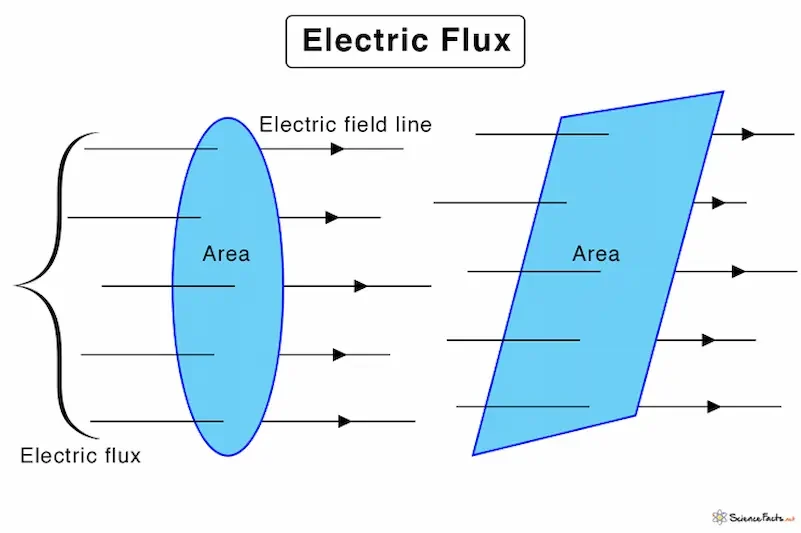
Electric flux is an important concept in physics that helps explain how an electric field passes through a surface. It is closely connected to Gauss law because the law uses total electric flux to describe the relationship between electric fields and enclosed electric charges. Understanding electric flux makes it easier to learn how Gauss law works and how it can be used to solve physics problems.
What Is Electric Flux?
Electric flux measures how much of an electric field passes through a given surface. It depends on the strength and direction of the electric field and the area and orientation of the surface. Electric flux is represented by the symbol \(\Phi_E\).
Imagine sunlight passing through a window. When sunlight falls directly on the window, more light passes through it. When the window is tilted, less light passes through the same area. Electric flux works in a similar mathematical way, although it describes an electric field rather than light.
Formula for Electric Flux
For a uniform electric field passing through a flat surface, electric flux is calculated using this formula:
\[ \Phi_E=EA\cos\theta \]
Here, each symbol has a specific meaning:
- \(\Phi_E\) represents electric flux.
- \(E\) represents the electric field strength.
- \(A\) represents the surface area.
- \(\theta\) represents the angle between the electric field and the surface’s perpendicular direction, called the area vector.
This formula shows that electric flux depends on how strongly the electric field passes through the surface.
How Does the Angle Affect Electric Flux?
The angle between the electric field and the area vector affects the amount of electric flux.
1. When the electric field is perpendicular to the surface: The area vector points in the same direction as the field, so the flux is maximum and positive.
2. When the electric field is parallel to the surface: The field does not pass through the surface in the perpendicular direction, so the electric flux is zero.
3. When the electric field points opposite to the area vector: The flux is negative because the field enters the surface relative to the chosen outward direction.
These examples show why the direction of an electric field is important when calculating electric flux.
What Is the SI Unit of Electric Flux?
The SI unit of electric flux is newton-square metres per coulomb, written as \(\text{N}\cdot\text{m}^2/\text{C}\). This unit comes from multiplying electric field strength, measured in newtons per coulomb, by surface area, measured in square metres.
Electric flux can be positive, negative, or zero depending on the field’s direction and the surface’s orientation.
Relationship Between Electric Flux and Gauss Law
Electric flux is the central concept behind Gauss law. For a closed surface, the law states that the net electric flux depends on the total enclosed charge divided by the permittivity of free space. Positive enclosed charge produces positive net flux, while negative enclosed charge produces negative net flux.
For example, if a closed sphere surrounds a positive electric charge, the total electric flux through the sphere is outward. If the sphere surrounds no net charge, the total electric flux is zero, even if electric fields pass through different parts of the surface.
Why Is Electric Flux Important?
Electric flux helps students understand how electric fields interact with surfaces and why enclosed charge matters in Gauss law. It is useful for studying charged spheres, cylinders, and flat sheets. By understanding electric flux, students can better understand Gauss law and apply it to different electrostatic problems.
What Is Gauss Law in Simple Words?
Gauss law is a basic principle of physics that explains the relationship between electric charge and electric flux through a closed surface. It states that the total electric flux through a closed surface depends on the net electric charge enclosed within it.
What Is the Formula for Gauss Law?
The formula for Gauss law is:
\[ \oint_S \vec{E}\cdot d\vec{A}=\frac{Q_{\text{enc}}}{\varepsilon_0} \]
It means that the total electric flux through a closed surface equals the enclosed net charge divided by the permittivity of free space.
Who Discovered Gauss Law?
Gauss law is named after Carl Friedrich Gauss, a German mathematician and physicist who made important contributions to mathematics and science. The law is now one of the fundamental principles of electromagnetism.
Conclusion
Gauss law is a fundamental principle of physics that explains the relationship between electric flux and the electric charge enclosed within a closed surface. It helps students understand how electric fields behave and how they can be calculated around different charged objects. By learning the Gauss law formula, understanding electric flux, and studying Gaussian surfaces, students can solve many electrostatics problems more easily. This law is especially useful for symmetrical charge distributions, such as spheres, cylinders, and flat sheets. Although calculating electric fields is not always simple for irregular charge distributions, Gauss law remains an essential part of electromagnetism. Understanding its concepts and practicing numerical examples can help students build a strong foundation in physics.